
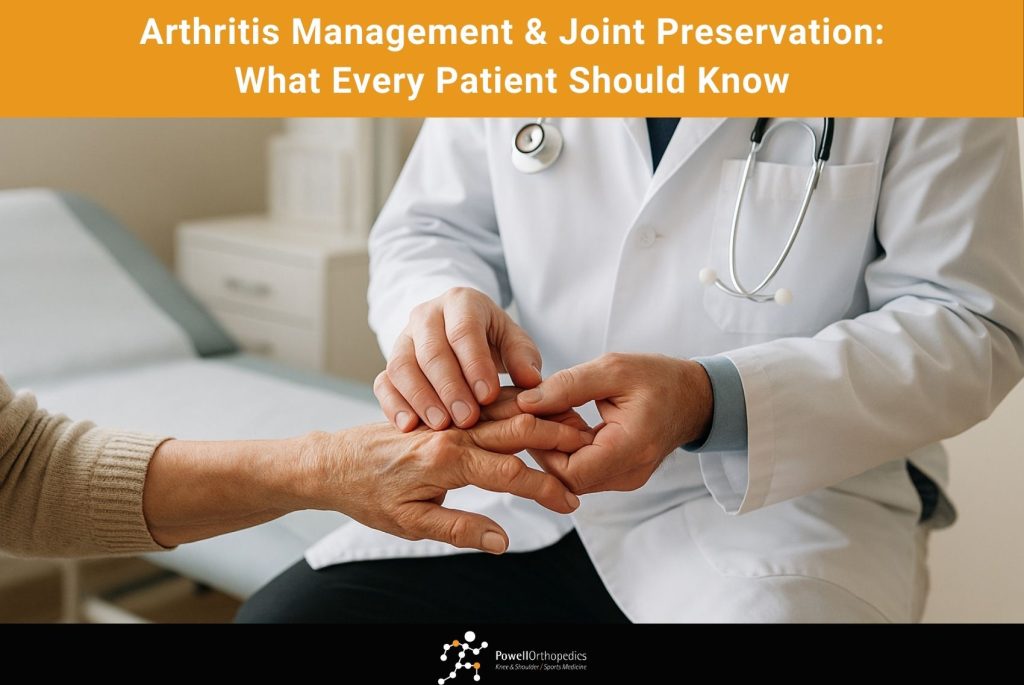
Understanding Arthritis
Arthritis is one of the most common causes of joint pain and stiffness in adults. The term “arthritis” does not refer to a single condition; instead, it describes inflammation inside a joint, which can result from many different underlying causes.
Arthritis may develop slowly over time, or appear suddenly after injury, illness, or repetitive strain. Symptoms can range from mild discomfort to chronic pain that affects work, exercise, and daily activities. Although arthritis cannot always be “cured,” it can be effectively managed — and in many cases, symptoms can be greatly reduced with the right approach.
At Powell Orthopedics, our goal is to preserve natural joint function, reduce pain, and maintain or improve mobility — helping patients stay active and independent.
How Healthy Joints Function
To understand arthritis, it’s helpful to know how a healthy joint works.
A joint is where two bones meet. Most joints (like knees, shoulders, and hips) contain:
| Structure | Function |
| Cartilage | Smooth tissue that cushions and protects bone surfaces |
| Synovial Fluid | Lubricates the joint and reduces friction |
| Joint Capsule & Ligaments | Hold bones in place and allow stable movement |
| Tendons & Muscles | Provide motion and support |
When these structures are inflamed, worn down, or damaged, arthritis may develop.
Types of Arthritis
There are over 100 forms of arthritis. The most common include:
1. Osteoarthritis (Degenerative Arthritis)
- The most common type
- Caused by gradual wear-and-tear of cartilage
- Often affects knees, hips, hands, and spine
- Symptoms worsen over time but can be managed
2. Rheumatoid Arthritis (Autoimmune Arthritis)
- The immune system mistakenly attacks joint tissue
- Causes inflammation of the joint lining
- Can affect multiple joints at once, often symmetrically (both wrists, both knees, etc.)
- Requires coordinated care with medical providers
3. Post-Traumatic Arthritis
- Develops after a joint injury, such as a fracture or ligament tear
- Can appear months or years after the injury
4. Gout & Crystal-Induced Arthritis
- Caused by crystal deposits in the joint
- Pain often begins suddenly and can be severe
Regardless of type, arthritis leads to inflammation → pain → stiffness → reduced movement.
Common Symptoms of Arthritis
Symptoms may vary in severity and pattern, but often include:
| Symptom | Description |
| Pain | Aching or sharp discomfort during movement or rest |
| Stiffness | Particularly noticeable in the morning or after inactivity |
| Swelling | Joint appears puffy or feels warm to the touch |
| Reduced Range of Motion | Trouble bending, straightening, or rotating the joint |
| Weakness or Instability | Muscles around the joint may weaken due to pain-limited use |
| Grinding or Clicking Sensation | Indicates cartilage thinning or roughened joint surfaces |
Symptoms may come and go, or they may gradually become more noticeable over time.
Why Early Evaluation Matters
Without early and appropriate care, arthritis can lead to:
- Increasing pain and stiffness
- Shrinking of supportive muscles
- Altered movement patterns that stress other joints
- Reduced independence in daily activities
Early diagnosis helps slow progression and allows for joint preservation strategies — proactive steps that protect long-term function.
How Arthritis Is Diagnosed
1. Detailed Medical History
We discuss:
- When symptoms began
- Where pain is located
- What activities worsen or improve symptoms
- Prior injuries or repetitive use
2. Physical Examination
Your orthopedic provider evaluates:
- Joint alignment
- Swelling or warmth
- Range of motion
- Pain patterns
- Muscle strength and flexibility
3. Imaging
| Test | What It Shows |
| X-ray | Joint space narrowing, bone spurs, cartilage loss |
| MRI | Early cartilage changes, ligament and tendon issues |
| Ultrasound | Joint fluid and soft tissue inflammation |
4. Lab Work (When Needed)
To evaluate inflammatory or autoimmune arthritis.
Treatment Options at Powell Orthopedics
Arthritis treatment is personalized. The right approach depends on:
- Type of arthritis
- Severity of symptoms
- Which joints are affected
- Activity level and lifestyle goals
We utilize stepwise care, beginning with the most conservative effective options.
1. Activity Modification
Certain daily adjustments can significantly reduce symptoms:
- Avoid repetitive high-strain movement
- Use ergonomic and joint-friendly posture techniques
- Modify exercise intensity rather than stopping movement altogether
Movement is important — joints become stiffer when not used.
2. Medication (When Medically Appropriate)
| Type | Purpose |
| NSAIDs (Anti-inflammatories) | Reduce swelling and pain |
| Topical analgesics | Useful for local joint discomfort |
| Oral or injectable steroid medication | Short-term relief during flare-ups |
| Disease-modifying medications (RA only) | Managed with rheumatology collaboration |
Medication is never the only solution; it is part of a balanced plan.
3. Physical Therapy & Exercise
Movement is one of the most powerful arthritis treatments.
Therapy focuses on:
- Strengthening muscles around the joint
- Improving flexibility and range of motion
- Restoring proper movement mechanics
- Reducing stress on irritated joint surfaces
Consistent exercise can dramatically improve comfort and function.
4. Supportive Bracing and Assistive Devices
In selected situations:
- Offloading braces can reduce pain in weight-bearing joints
- Hand or wrist braces may improve joint stability
- Shoe inserts help align foot and knee movement patterns
5. Injection Therapies
Depending on joint and severity:
| Injection | How It Helps |
| Corticosteroid Injection | Quickly reduces inflammation and pain |
| Hyaluronic Acid Injection | Improves joint lubrication and mobility |
| Platelet-Rich Plasma (PRP) | Supports natural tissue healing and reduces inflammation |
These treatments do not replace exercise therapy — instead, they make exercise more tolerable and effective.
When to Seek Care Immediately
Contact a provider promptly if you experience:
- Sudden, severe joint pain and swelling
- Joint redness or warmth with fever (possible infection or gout)
- Sudden inability to bear weight on a joint
- Rapid onset of numbness, joint locking, or loss of mobility
These symptoms are not typical of slowly progressing arthritis and require timely evaluation.
Patient-Friendly Q&A
Is arthritis curable?
There is no cure, but arthritis is very manageable. With the right plan, many patients maintain excellent mobility and comfort.
Should I stop exercising if I have arthritis?
No. Controlled movement is one of the best treatments for arthritis.
The focus should be on low-impact, joint-friendly exercise.
Will arthritis always get worse?
Not necessarily. Early treatment can slow progression and preserve joint function for years or longer.
Do injections fix arthritis?
Injections reduce symptoms and can improve joint function, but they do not reverse cartilage loss. They are part of a comprehensive management approach.
When is surgery considered?
If pain persists despite optimized non-surgical care, surgical options may be discussed. However, we do not perform total joint replacements at Powell Orthopedics and instead focus on joint preservation, soft tissue repair, and conservative intervention.
You Don’t Have to Live with Daily Joint Pain
Arthritis can feel frustrating — but with the right care strategy, patients regain control of mobility, activity, and comfort. We’re here to guide you every step of the way.
Powell Orthopedics
1450 East Zion Rd., Suites 6 & 10
Fayetteville, AR 72703
Phone: (479) 582-4647
Website: powellorthopedics.com
Schedule Online: https://powellorthopedics.com/appointments/