
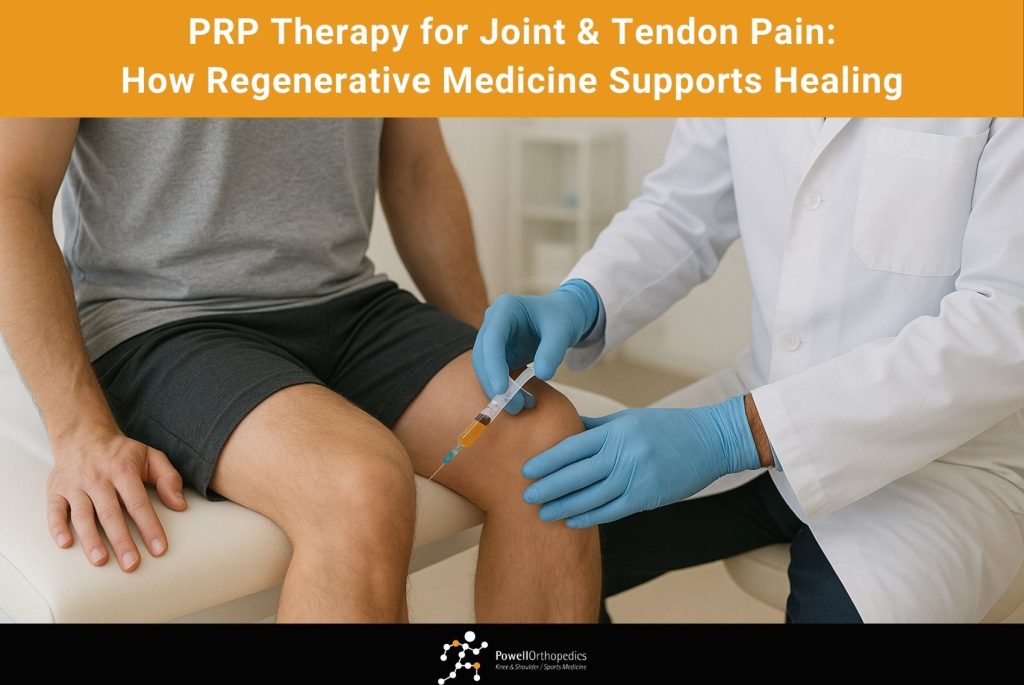
What is Platelet-Rich Plasma (PRP) Therapy?
Platelet-Rich Plasma — commonly called PRP — is a regenerative treatment that uses the healing components of your own blood to support the recovery of damaged tissues. PRP therapy has become an important non-surgical treatment option for:
- Tendon injuries
- Mild to moderate arthritis
- Chronic inflammation in joints
- Sports-related soft tissue injuries
- Post-injury recovery to support healing
PRP is often selected by patients who:
- Want to avoid or delay surgery
- Prefer a natural, biologically-based treatment
- Have not experienced full relief from physical therapy, rest, medication, or cortisone injections
- Want to support healing rather than just masking pain
At Powell Orthopedics, PRP is used thoughtfully and only in cases where it is clinically appropriate — ensuring patients receive treatments supported by evidence and tailored to their individual needs.
How PRP Works
Your blood contains several key components:
| Component | Purpose |
| Red Blood Cells | Carry oxygen |
| White Blood Cells | Support immune function |
| Platelets | Contain growth factors that promote healing |
PRP therapy works by concentrating platelets — which are naturally responsible for tissue repair — and delivering them directly to the injured area.
Step-by-Step Breakdown:
- A small sample of blood is taken from your arm, similar to a routine lab draw.
- The blood is placed in a centrifuge, a specialized machine that spins rapidly to separate platelets from other blood components.
- The result is platelet-rich plasma that contains 3–10 times more platelets than your normal blood.
- The PRP is injected carefully into the injured joint, tendon, or ligament under sterile technique (and ultrasound guidance when indicated for precision).
Once injected, PRP releases growth factors that help:
- Reduce inflammation
- Stimulate tissue repair
- Support new collagen formation
- Improve tendon and ligament healing
- Enhance joint lubrication and function
Unlike cortisone, which reduces pain but may slow tissue repair if used repeatedly — PRP focuses on healing and improving function over time.
Conditions Commonly Treated with PRP
PRP can be beneficial for:
Tendon Conditions
- Rotator cuff tendon irritation
- Tennis elbow (lateral epicondylitis)
- Golfer’s elbow (medial epicondylitis)
- Achilles tendon irritation
- Patellar tendonitis (“jumper’s knee”)
Joint and Cartilage Conditions
- Mild to moderate osteoarthritis (knee, shoulder, wrist, or ankle)
- Early cartilage thinning or wear-and-tear
- Chronic inflammation around joints
Sports-Related Injuries
- Overuse injuries that have not improved with rest and therapy
- Chronic muscle or tendon strain injuries
What to Expect During the Procedure
Appointment Timeline:
- The entire visit generally takes about 45–60 minutes
- The injection itself often takes only a few minutes
Discomfort Level:
You may feel temporary pressure or soreness during the injection. Most patients tolerate the procedure well — especially with appropriate anesthetic techniques.
After the Injection:
It is normal to experience:
- Soreness for several days
- Warmth or fullness sensation at the injection site
- Temporary increase in symptoms
This occurs because the body’s healing response has been activated.
Recovery and Activity Guidelines
| Time After Injection | What to Expect / Activity Recommendation |
| First 48–72 hours | Mild soreness is common; use ice if needed. Avoid anti-inflammatory medication (as it can interfere with healing). |
| Week 1–2 | Gradual return to light daily activities. Avoid heavy lifting or strenuous exercise. |
| Week 3+ | Begin guided physical therapy to restore motion and strength. |
| 4–8+ weeks | Improvement becomes more noticeable as tissue healing continues. |
PRP is not a quick fix — it is a healing process. Many patients continue to see gradual improvement over 8–12 weeks.
How PRP Compares to Other Injections
| Injection | Purpose | Duration of Relief | Healing Effect |
| Cortisone | Reduces inflammation | Weeks to months | Does not promote healing |
| Hyaluronic Acid | Improves joint lubrication | Months | Does not rebuild tissue |
| PRP | Supports natural tissue repair | Months to long-term | Promotes healing at the cellular level |
PRP is often used as a next-step treatment when other conservative options have not provided sufficient relief.
Who is a Good Candidate for PRP Therapy?
PRP may be appropriate if you:
- Have chronic tendon irritation
- Have mild or moderate arthritis
- Want to delay or avoid surgery
- Prefer a biologic therapy over medication-based management
- Are committed to a rehabilitation program to support healing
PRP may not be recommended if you:
- Have a bleeding disorder
- Take certain blood-thinning medications that cannot be paused
- Have active infection
- Have severe arthritis where the joint surface is significantly worn down
Your orthopedic specialist will explain whether PRP is likely to be effective for your condition.
When to Seek Care Immediately After PRP
Although complications are uncommon, contact us promptly if you experience:
- Severe or worsening pain not relieved by rest
- Rapid swelling or redness that increases over 24–48 hours
- Fever or chills
- Numbness, tingling, or loss of limb function
These symptoms are rare but require prompt evaluation.
Frequently Asked Questions (Patient-Friendly)
How soon will I feel results?
Most patients notice improvement gradually, starting around 4–6 weeks, with continued improvement for several months.
Is PRP painful?
There may be temporary soreness, but most patients tolerate the injection well.
Why can’t I take ibuprofen or other anti-inflammatories afterward?
Anti-inflammatory medications may slow the healing response that PRP is designed to activate. Acetaminophen is generally allowed for pain relief.
Will I need more than one treatment?
Some patients benefit from a series of 2–3 injections, spaced several weeks apart. Others respond well to a single treatment.
Does insurance cover PRP?
In many cases, insurance does not cover PRP because it is considered a regenerative therapy. We will review costs with you prior to treatment.
Take the Next Step Toward Healing
If chronic tendon pain, joint inflammation, or a sports injury is limiting your activity, PRP may be an effective next step in your recovery.
Powell Orthopedics
1450 East Zion Rd., Suites 6 & 10
Fayetteville, AR 72703
Phone: (479) 582-4647
Website: powellorthopedics.com
Schedule Online: https://powellorthopedics.com/appointments/
_____________________________________________