
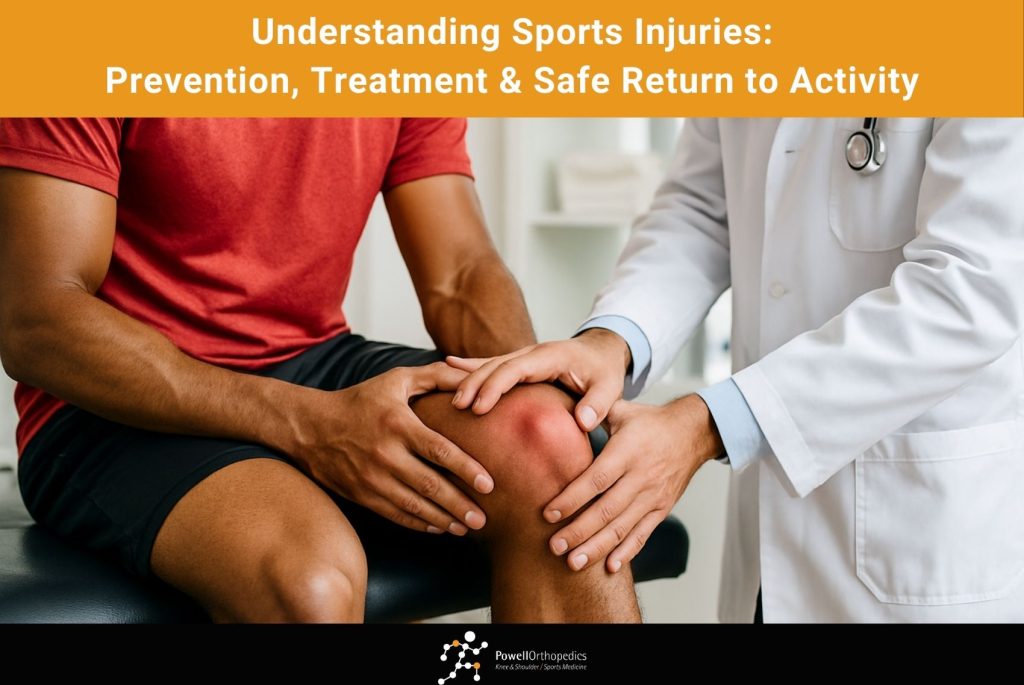
Understanding Sports Injuries
Sports and physical activity are essential for health — strengthening muscles, improving cardiovascular function, and supporting overall wellness. However, athletic movement can also place significant stress on bones, joints, tendons, and ligaments. Whether you are a competitive athlete, a weekend hiker, or someone staying active to maintain fitness, injuries can happen.
A sports injury refers to any musculoskeletal injury that occurs during physical exercise, training, or athletic competition. These injuries may develop suddenly (acute) or gradually over time (chronic or overuse).
At Powell Orthopedics, we provide specialized evaluation and individualized treatment for sports-related injuries to restore strength, motion, and safe function—while helping prevent future injury.
Common Causes of Sports Injuries
Sports injuries may result from:
- Sudden directional changes
- Twisting or pivoting movements
- High-impact collisions or falls
- Overuse without adequate recovery
- Improper warm-up or conditioning
- Muscle imbalance or reduced flexibility
- Fatigue or training errors
The risk is not limited to competitive athletes — active adults and even children participating in recreational sports can experience injury.
Types of Sports Injuries
Sports injuries can affect many tissues, including muscles, bones, tendons, ligaments, and cartilage. Below are some of the most commonly treated conditions seen at Powell Orthopedics.
1. Sprains
Injuries to ligaments (tissues that connect bone to bone).
Example: Ankle sprain → twisting the foot inward during a run.
2. Strains
Injuries to muscles or tendons (tissues connecting muscle to bone).
Example: Hamstring strain during sprinting.
3. Tendonitis
Repetitive stress can cause tendon inflammation.
Example: Tennis elbow or jumper’s knee.
4. Ligament Tears
Sudden forces can tear stabilizing ligaments.
Example: ACL tear or UCL tear in baseball pitchers.
5. Meniscus Tears
Pivoting can tear the cushioning cartilage inside the knee.
6. Stress Fractures
Small cracks in bone due to repetitive stress, common in runners.
7. Shoulder Injuries
Including rotator cuff injuries, bursitis, and labral tears.
Each injury requires a tailored approach — not just to heal the affected tissue, but to restore safe biomechanics and full performance.
Symptoms of Sports Injuries
Symptoms vary widely based on the structure involved, but may include:
| Symptom | What It May Signal |
| Pain during activity | Muscle or tendon irritation |
| Swelling or bruising | Tissue injury or inflammation |
| Stiffness / limited range of motion | Joint involvement |
| Weakness or instability | Ligament or tendon injury |
| Locking or catching sensation | Cartilage tear |
| Numbness or tingling | Nerve irritation or compression |
If symptoms interfere with motion or daily life, prompt evaluation is recommended.
Why Early Evaluation Matters
Many athletes try to “play through” pain — but delaying care can worsen injury and prolong recovery time.
Early evaluation allows:
- Accurate diagnosis of the injury source
- Prevention of further tissue damage
- Faster return to activity
- Customized rehabilitation planning
- Identification of technique or training issues contributing to injury
Our goal is always to preserve natural movement and protect joint health long-term.
How Sports Injuries Are Diagnosed
Clinical Examination
Your orthopedic provider will assess:
- Range of motion of the affected joint
- Muscle strength and balance
- Joint alignment and stability
- Pain patterns during specific movements
Imaging When Needed
| Test | Purpose |
| X-ray | Rules out fracture or joint alignment issues |
| Ultrasound | Evaluates real-time tendon or muscle motion |
| MRI | Identifies ligament, tendon, and cartilage tears |
Accurate diagnosis ensures the most effective treatment plan.
Treatment Options at Powell Orthopedics
1. Non-Surgical Treatment
Most sports injuries improve with conservative care.
This may include:
- Rest and activity modification
- Ice, heat, or compression therapy
- Anti-inflammatory medications when medically appropriate
- Immobilization or bracing
- Structured physical therapy
Physical therapy is essential to:
- Restore proper movement mechanics
- Rebuild supportive muscle strength
- Improve balance, stability, and coordination
- Prevent reinjury when returning to activity
2. Injection Therapies
Depending on the injury type, injections may assist healing:
| Injection Type | Benefit |
| Corticosteroid | Reduces inflammation and pain |
| PRP (Platelet-Rich Plasma) | Uses your body’s own growth factors to support tissue healing |
| Hyaluronic acid | Improves joint lubrication in arthritic or cartilage-irritated joints |
Your physician will discuss whether injection therapy is appropriate for your condition.
3. Surgical Treatment (When Necessary)
Surgery may be considered when:
- Ligaments are completely torn
- The joint is unstable
- Cartilage damage is causing mechanical symptoms
- Conservative treatment does not provide relief
At Powell Orthopedics, we focus on minimally invasive arthroscopic techniques to preserve tissue and promote efficient recovery.
Return-to-Sport Planning
The return-to-sport timeline depends on the injury, treatment type, and healing progress. Progression is based on function, not just time.
Return-to-sport phases may include:
- Pain-free daily movement
- Restored strength and flexibility
- Sport-specific training progression
- Gradual re-introduction to high-intensity activity
Our team works closely with patients to ensure safe, confident return to the activities they love.
When to Seek Care Immediately
Contact a healthcare provider right away if you experience:
- Inability to bear weight on the injured limb
- Visible deformity (bone or joint alignment appears abnormal)
- Rapid swelling immediately after injury
- Severe pain that does not improve with rest
- Numbness, tingling, or loss of circulation
- A joint that locks and cannot straighten or bend
Prompt evaluation helps prevent long-term complications.
Patient-Friendly Q&A
Can I treat a sports injury at home?
Mild strains and overuse injuries can often improve with rest and guided exercises. However, persistent pain, swelling, or weakness should be evaluated professionally.
How long does recovery take?
Recovery varies widely — from days for mild strains to months for ligament tears. Treatment plans are individualized.
Is physical therapy always required?
For most sports injuries, yes. Therapy helps restore proper mechanics and reduces the risk of reinjury.
Can I return to activity before pain is gone?
No. Pain is the body’s warning signal — returning too early increases the risk of more serious injury.
Take the Next Step Toward Full Recovery
You don’t have to navigate a sports injury alone. Whether your goal is returning to the playing field or simply moving comfortably again, we are here to help.
Powell Orthopedics
1450 East Zion Rd., Suites 6 & 10
Fayetteville, AR 72703
Phone: (479) 582-4647
Website: powellorthopedics.com
Schedule Online: https://powellorthopedics.com/appointments/