
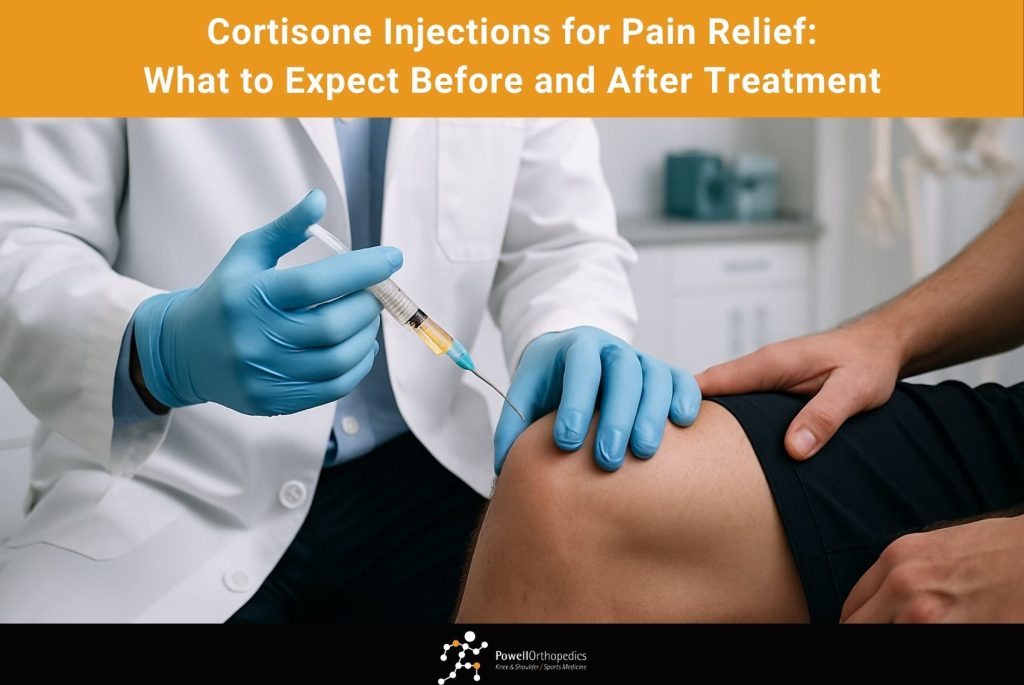
Understanding Cortisone Injections
When joint pain, swelling, or tendon irritation interferes with daily activity, work performance, or exercise, a cortisone injection may be recommended as part of your treatment plan. Cortisone (a type of corticosteroid) is a naturally occurring hormone that helps regulate inflammation in the body. In medical treatment, it is used in concentrated, targeted form to reduce inflammation directly at the site of pain.
Unlike pain medications that simply mask symptoms, cortisone reduces the underlying inflammatory response that causes pain, swelling, and stiffness. This can provide meaningful and sometimes rapid relief — allowing patients to move more comfortably, participate in physical therapy, and progress toward long-term recovery goals.
At Powell Orthopedics, cortisone injections are used strategically and only when medically appropriate as part of a broader joint preservation and functional recovery approach.
Why Inflammation Causes Joint Pain
Inflammation is the body’s natural healing response — but sometimes, the inflammation lasts longer than necessary or becomes excessive, causing discomfort and limiting movement.
When a joint is inflamed:
- The synovial lining may become irritated
- Excess joint fluid may form, leading to swelling
- Tendons may thicken or tighten from overuse
- Cartilage may experience increased stress
- The joint may feel stiff, warm, or painful
A cortisone injection interrupts this inflammatory cycle, allowing the body to regain more normal movement and comfort.
Conditions Cortisone Injections Can Help Treat
Cortisone injections are commonly used to treat:
| Condition | How Cortisone Helps |
| Arthritis (including osteoarthritis) | Reduces joint inflammation and stiffness |
| Tendonitis | Calms thickened or irritated tendons |
| Bursitis | Decreases swelling in fluid-filled sacs that reduce friction in joints |
| Rotator Cuff Impingement | Relieves pressure around the shoulder tendons |
| Plantar Fasciitis | Reduces heel inflammation and morning pain |
| Carpal Tunnel Syndrome | Shrinks swelling in the wrist canal to reduce nerve pressure |
| Meniscus Irritation or Knee Synovitis | Reduces fluid build-up and improves comfort |
Cortisone is not a cure for these conditions. It is one tool used to reduce symptoms so that physical therapy, structured exercise, and joint-preserving treatment can be more effective.
How the Injection Is Performed
Step-by-Step Process:
- The injection area is cleaned and prepared using sterile technique.
- Local anesthetic may be applied to reduce injection discomfort.
- Cortisone is injected into the joint, bursa, or tendon sheath, depending on the condition.
- In some cases, the injection is performed under ultrasound guidance to ensure precision.
The actual injection typically takes just a few seconds.
Discomfort Level
Most patients describe the sensation as:
- A moment of pressure
- Brief pinching
- Followed by gradual relief
If a local anesthetic is included in the injection, some pain relief may be felt immediately (this wears off in a few hours and should not be confused with the effect of cortisone, which takes longer to activate).
What to Expect After the Injection
First 24–72 Hours
It is common to experience:
- Temporary increase in soreness
- Feeling of fullness or pressure in the joint
- Mild redness or warmth at the injection site
This is known as a “post-injection flare.” It usually improves with:
- Rest
- Ice (10–15 minutes at a time)
- Acetaminophen for discomfort (avoid NSAIDs for 24 hours unless instructed)
When Relief Begins
Cortisone typically begins working within:
- 48–72 hours (common)
- Up to 7 days (for slower responders)
Relief may last:
- Several weeks to several months
- Depending on the condition and inflammation severity
Benefits of Cortisone Injections
- Reduces inflammation
- Improves range of motion
- Allows more comfortable participation in physical therapy
- Helps break the pain-spasm-stiffness cycle
- Can help avoid or delay surgical treatment in appropriate cases
Cortisone is often used to create the window of comfort needed for exercise-based recovery — which is the most effective long-term treatment for many conditions.
Limitations and Considerations
While cortisone is a helpful tool, it must be used responsibly.
Cortisone is NOT:
- A cure for arthritis
- A replacement for exercise or physical therapy
- A treatment that should be repeated frequently
Injection Frequency
In most cases, cortisone is limited to:
- No more than 3 injections per year in the same joint region
- Spacing injections at least several weeks apart
Excessive use may:
- Irritate tissues
- Increase cartilage wear
- Weaken tendon structure
Your provider will guide what is appropriate and safe for your situation.
When to Seek Care Immediately
While complications are uncommon, contact our office promptly if you experience:
- Severe or worsening pain beyond the first 48–72 hours
- Redness, warmth, or swelling that increases instead of improves
- Fever or chills (could indicate infection)
- Numbness, tingling, or sudden loss of joint function
- Rash or allergic reaction near the injection site
These symptoms are not typical and require timely evaluation.
Patient-Friendly Q&A
How long does a cortisone injection last?
Relief varies. Some patients feel better for weeks, others for months. Your activity level, inflammation severity, and treatment plan influence duration.
Can I exercise after the injection?
Avoid strenuous activity for 48 hours, then gradually resume exercise. Physical therapy may be recommended to reinforce good movement patterns.
Is cortisone the same as pain medication?
No. Pain medications reduce discomfort; cortisone reduces the source of pain by decreasing inflammation.
Will I eventually need surgery if my arthritis is treated with cortisone?
Not necessarily. Many patients maintain comfortable activity levels for years using exercise therapy, occasional injections, joint unloading strategies, and activity adjustments.
Is cortisone safe?
Yes — when used appropriately, at medically guided intervals, and within a comprehensive treatment plan.
Moving Forward: Your Personalized Path to Relief
A cortisone injection is not the final solution — it is the starting point toward:
- Improved mobility
- Reduced pain
- Better function
- Long-term joint sustainability
The next step often involves strengthening and movement retraining through physical therapy — which we will guide and support.
Schedule Your Evaluation
If joint or tendon pain is interfering with work, recreation, or daily life, we are here to help — with treatment options tailored to your goals.
Powell Orthopedics
1450 East Zion Rd., Suites 6 & 10
Fayetteville, AR 72703
Phone: (479) 582-4647
Website: powellorthopedics.com
Schedule Online: https://powellorthopedics.com/appointments/