
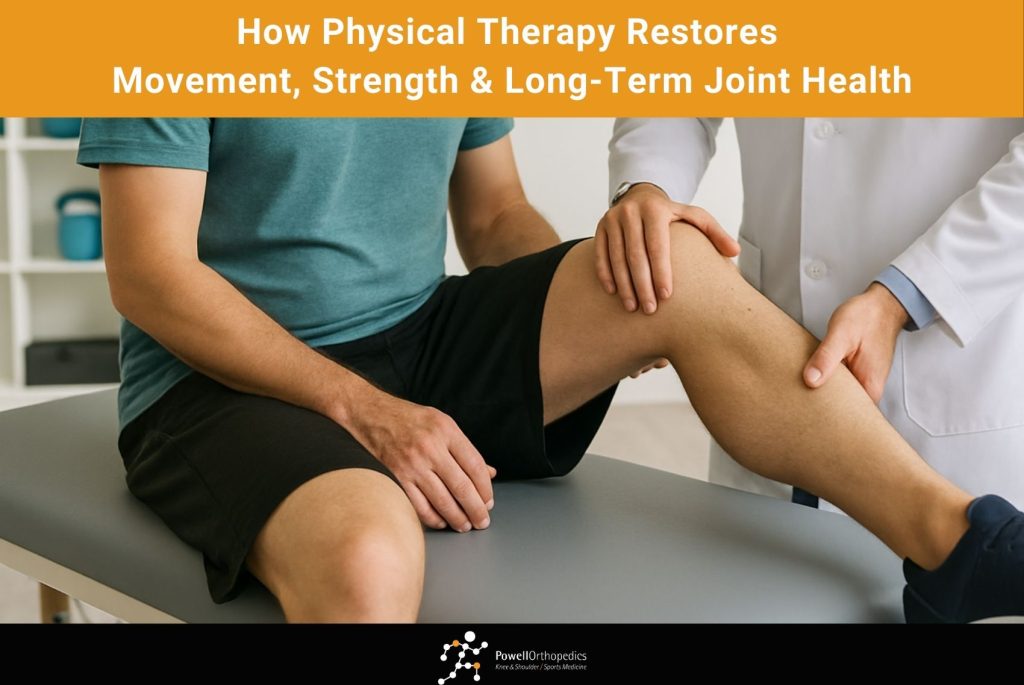
The Role of Physical Therapy in Orthopedic Recovery
Physical therapy is one of the most important and effective components of orthopedic care. Whether recovering from an injury, managing arthritis, improving joint health, or preparing for or healing after a procedure, physical therapy provides the foundation for movement restoration, pain reduction, and long-term joint preservation.
Unlike medication or injections — which help relieve symptoms — physical therapy addresses the root cause of pain by retraining how the body moves, builds strength, and maintains stability. It is the process that helps your body repair, adapt, rebuild, and regain confidence in movement.
At Powell Orthopedics, we integrate physical therapy into treatment plans for nearly every condition we manage, because restoring movement patterns and improving muscular support is key to preventing recurrence and maintaining long-term joint health.
Why Movement Matters
When you experience pain, your body naturally tries to avoid the motion that hurts. While this is a protective response, long-term movement avoidance can create new problems, including:
- Muscle weakness
- Joint stiffness
- Poor posture or alignment
- Overloading nearby joints
- Increased pain sensitivity
Left untreated, the body develops compensation patterns — ways of moving that seem easier short-term, but place stress on other tissues.
Physical therapy helps:
- Break the pain-avoidance cycle
- Restore healthy, efficient movement patterns
- Build strength and control around the affected joint
- Improve balance, coordination, and posture
Movement, when guided correctly, is medicine.
What Physical Therapy Helps Treat
We commonly prescribe physical therapy for:
| Condition | How PT Helps |
| Meniscus Tears | Restores knee strength & joint stability during recovery |
| ACL or Ligament Injuries | Rebuilds muscle control to protect joint from re-injury |
| Rotator Cuff Injuries | Strengthens shoulder support and improves range of motion |
| Carpal Tunnel Syndrome | Improves wrist mechanics & relieves tendon irritation |
| Tendonitis | Reduces strain on irritated tendon fibers & improves tissue alignment |
| Plantar Fasciitis | Restores foot mechanics and reduces heel stress |
| Sports Injuries | Tailors recovery to activity demands and gradual return to sport |
| Osteoarthritis & Arthritis | Strengthens supportive muscles to protect cartilage and reduce pain |
| Chronic Shoulder or Knee Pain | Corrects movement faults contributing to discomfort |
Everyone’s body adapts differently, so physical therapy is individualized — not one-size-fits-all.
How Physical Therapy Works
1. Assessment
Your therapist evaluates:
- Posture
- Joint alignment
- Strength imbalances
- Flexibility limitations
- Movement patterns (walking, lifting, bending, reaching)
This helps identify not just where it hurts — but why.
2. Manual Therapy (When Needed)
This may include:
- Gentle joint mobilization
- Soft tissue release
- Stretching techniques
- Scar or fascia management after injury
Manual treatment helps prepare the body to move more effectively.
3. Strengthening and Stability Training
This is the core of orthopedic recovery.
Therapy focuses on:
- Rebuilding weakened muscle groups
- Improving coordination between muscle systems
- Training stabilizing muscles that protect joints during movement
This creates better structural support — decreasing stress on irritated tissues.
4. Movement Retraining and Functional Exercise
Rehabilitation retrains how you move, not just how strong you are.
This may include:
- Gait (walking) training
- Balance and core control
- Safe lifting or reaching strategies
- Sport-specific or work-specific movement tasks
This reduces the risk of re-injury and supports long-term improvement.
5. Education & Long-Term Strategies
Understanding your condition empowers recovery.
Patients learn:
- How to manage flare-ups
- Which activities to modify (not avoid)
- How to stretch and strengthen independently
- How to prevent overuse injury
Physical therapy builds the skills to maintain comfort and mobility for the long term.
Why Physical Therapy Is Often More Effective Than Rest Alone
Rest reduces pain temporarily.
But without restoring movement, pain usually returns when activity resumes.
Therapy restores function.
It helps build the strength, flexibility, and joint support needed to move without recurring pain.
How Long Physical Therapy Takes
The length of therapy depends on:
- The condition or injury
- How long symptoms have been present
- Activity level and goals
- Individual healing response
| Condition | Approx. Duration (Varies by Individual) |
| Mild Tendonitis | 3–6 weeks |
| Meniscus or Knee Strain | 6–12 weeks |
| Rotator Cuff Injury | 8–16 weeks |
| Chronic Arthritis Stiffness | Ongoing home exercise with periodic therapy support |
| ACL / Major Ligament Injury | Several months of progressive training |
Therapy is not a quick fix.
However — it is the most reliable path to lasting improvement.
When Physical Therapy is Combined with Other Treatments
Therapy is often paired with:
| Treatment | Reason |
| Cortisone Injection | Reduces inflammation so exercise is more comfortable |
| PRP Injection | Supports healing while therapy restores motion |
| Bracing or Taping | Provides temporary stability during strengthening phase |
| At-home exercise program | Reinforces gains between sessions |
These combinations are strategic and complementary, not substitutes for each other.
When to Seek Care Immediately
While physical therapy is very safe, contact us urgently if you experience:
- Sudden, sharp, or severe pain during exercise
- Rapid joint swelling or redness
- Numbness, tingling, or loss of coordination in a limb
- A joint that locks or cannot fully bend or straighten
- A fall, twist, or new injury during rehabilitation
These may indicate something more urgent requiring orthopedic evaluation.
Patient-Friendly Q&A
Will physical therapy hurt?
Therapy may cause discomfort, especially when working through stiffness — but it should not cause sharp pain. Discomfort during recovery is part of healing; pain is a signal to adjust.
How often will I need to go to therapy?
Most patients attend 1–3 sessions per week, depending on their condition and goals.
Can I do physical therapy on my own at home?
Home exercises are essential — but initial guidance is needed to ensure proper form and avoid reinforcing harmful movement patterns.
If therapy works, will I need to continue forever?
No — once strength and movement mechanics improve, most patients transition to a maintenance program they can perform independently.
Does physical therapy replace the need for surgery?
In many cases — yes.
When therapy is started early, some surgical procedures may be avoided.
If surgery is ever needed, therapy improves both pre-surgical condition and post-surgical recovery.
Therapy Helps You Move Confidently Again
The goal of physical therapy is not just pain relief — it is restoring your ability to move, work, exercise, and live confidently.
Whether you are recovering from injury or managing a chronic condition, we will guide you every step of the way.
Schedule Your Evaluation
Powell Orthopedics
1450 East Zion Rd., Suites 6 & 10
Fayetteville, AR 72703
Phone: (479) 582-4647
Website: powellorthopedics.com
Book Online: https://powellorthopedics.com/appointments/