
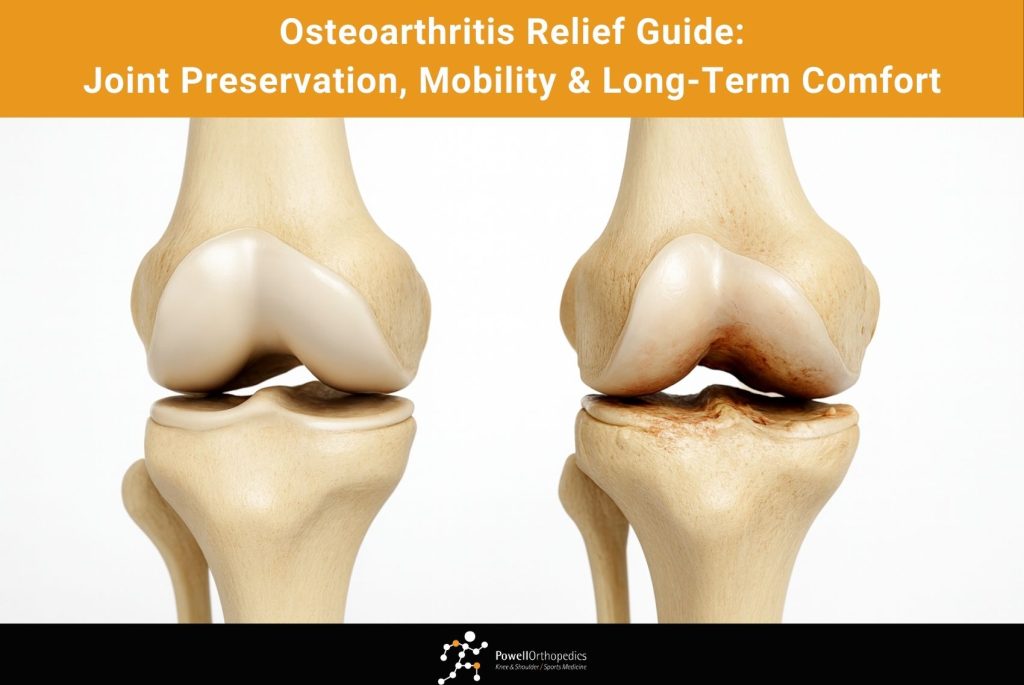
What Is Osteoarthritis?
Osteoarthritis (OA) is the most common form of arthritis — a degenerative joint condition in which the protective cartilage covering the ends of bones gradually breaks down over time. Cartilage provides smooth, gliding movement inside the joint and acts as a cushion to absorb shock. When cartilage becomes thinner, rougher, or damaged, bone can begin to rub against bone, leading to:
- Pain
- Stiffness
- Swelling
- Reduced mobility
- Joint friction or grinding sensations
Osteoarthritis is sometimes incorrectly described as “just part of aging,” but the condition is highly manageable, especially with early diagnosis and preventative joint preservation strategies. Many patients are able to remain active, comfortable, and independent with the right treatment approach.
At Powell Orthopedics, we focus on joint preservation, meaning we help patients protect and use their existing joint structure, minimize pain, and maintain long-term function — without joint replacement surgery.
How Does a Healthy Joint Work?
To understand osteoarthritis, it helps to understand normal joint structure.
| Joint Component | Role in Movement |
| Cartilage | Smooth, flexible tissue that prevents bone-on-bone contact |
| Synovial Fluid | Lubricates and nourishes cartilage |
| Joint Capsule & Ligaments | Stabilize the joint and allow controlled movement |
| Muscles & Tendons | Provide strength and coordinated motion |
In osteoarthritis, cartilage gradually loses its smooth, protective structure, leading to greater stress on the joint components.
Why Osteoarthritis Develops
Osteoarthritis develops due to a combination of mechanical stress, repetitive strain, and biological changes in joint cartilage.
Common Risk Factors
| Factor | How It Contributes |
| Age | Cartilage naturally becomes less resilient over time |
| Joint injury | Previous sprains, fractures, or ligament tears can accelerate wear |
| Repetitive use | Jobs or hobbies requiring repeated joint motion increase stress |
| Genetics | Joint alignment and cartilage quality can be inherited |
| Muscle weakness | Inadequate support increases joint load |
| Obesity | Additional weight increases joint force, especially in knees, hips, and feet |
However — age alone does not cause osteoarthritis. Many individuals never develop significant symptoms, even in later life. The difference is typically joint loading patterns, muscle strength, and activity modifications over time.
Symptoms of Osteoarthritis
Symptoms may begin subtly and progress gradually. Early signs may only appear during activity but become more persistent over time.
| Symptom | Description |
| Pain with movement | Especially after walking, climbing, lifting, or standing |
| Joint stiffness | Most noticeable in the morning or after sitting still |
| Swelling or warmth | Indicates inflammation inside the joint |
| Reduced range of motion | Harder to rotate, bend, or fully straighten the joint |
| Grinding or clicking sensation | Caused by roughened cartilage surfaces |
| Joint tenderness or pressure sensitivity | Particularly along the joint line |
Symptoms often flare and settle, rather than worsening in a strictly linear pattern.
Common Locations of Osteoarthritis
Although OA can affect any joint, it is most common in:
- Knee
- Shoulder
- Wrist and thumb
- Hip
- Neck and lower back
- Big toe / foot
Each location presents differently and requires tailored treatment.
Diagnosis of Osteoarthritis
Correct diagnosis matters — different causes of joint pain require different treatments.
Evaluation Includes:
- Medical history – symptom timeline, aggravating activities, injury history.
- Physical exam – assessing mobility, pain patterns, muscle strength, alignment.
- Imaging studies:
| Study | What It Shows |
| X-rays | Joint space narrowing, bone spurs, cartilage thinning |
| MRI | Early cartilage wear, ligament involvement, synovitis |
| Ultrasound | Fluid buildup or tendon irritation |
Diagnosis allows us to create a personalized joint preservation plan.
Treatment Philosophy at Powell Orthopedics
We focus on joint preservation, not joint replacement.
Our goals:
- Reduce pain and inflammation
- Improve strength and flexibility
- Correct joint loading and movement patterns
- Slow progression of cartilage wear
- Maintain mobility and activity
We use a stepwise, evidence-based approach, always starting with the least invasive effective options.
Non-Surgical Treatment Options
1. Activity Modification
Rather than stopping movement, we help find joint-smart alternatives such as:
- Switching from high-impact to low-impact exercise (e.g., cycling, swimming, elliptical)
- Adjusting work ergonomics
- Structuring rest and recovery intervals
Movement remains essential — motion is lubrication for joints.
2. Physical Therapy
Therapy is one of the most effective tools for osteoarthritis care.
Goals include:
- Strengthening key muscle groups that support the joint
- Improving alignment and gait mechanics
- Restoring mobility and flexibility
- Reducing mechanical stress during movement
When guided correctly, therapy can dramatically improve comfort and performance.
3. Medications (When Appropriate)
| Type | Role |
| NSAIDs | Reduce inflammation and pain |
| Topical anti-inflammatory creams | Useful for hands, knees, and feet |
| Acetaminophen | Helps with baseline discomfort |
| Short-term corticosteroid use | Helpful during moderate flare-ups |
Medication is never the only treatment — it complements physical therapy and lifestyle changes.
4. Bracing & Supportive Devices
Targeted, condition-appropriate bracing may:
- Improve joint alignment
- Decrease joint pressure
- Reduce pain during activity
Orthotics (shoe inserts) can also support lower extremity joint alignment.
5. Injection Therapies
| Injection Type | How It Helps |
| Corticosteroid Injection | Quick inflammation relief during flares |
| Hyaluronic Acid Injection | Improves lubrication and shock absorption |
| Platelet-Rich Plasma (PRP) | Supports tissue healing and reduces inflammation |
Treatment choice depends on the joint, severity, and patient goals.
When to Seek Care Immediately
While osteoarthritis typically progresses slowly, seek medical evaluation promptly if you experience:
- Sudden severe joint pain
- Joint redness, warmth, and fever (possible infection or gout)
- Inability to move or bear weight
- Rapid swelling without clear cause
- A joint that locks or catches suddenly
These symptoms suggest something more urgent than routine arthritis.
Patient-Friendly Q&A
Is osteoarthritis the same as “old age arthritis”?
Not exactly. Although age increases risk, osteoarthritis is influenced by activity patterns, injury history, genetics, and muscle strength.
Can osteoarthritis be reversed?
Cartilage loss cannot currently be reversed, but symptom control and progression slowing are highly achievable.
Will I need surgery?
Not necessarily. Many patients maintain excellent function with exercise therapy, bracing, and injection support, without needing surgical intervention.
Should I avoid exercise if I have osteoarthritis?
No. Exercise is essential. The key is choosing joint-friendly activity and proper movement patterns.
Do injections “fix” arthritis?
They reduce pain and improve function, helping you stay active — which is the most important long-term protection for joint health.
Take Control of Your Joint Health
You don’t have to live with ongoing pain or stiffness — and you don’t have to give up the activities you enjoy.
With early and personalized treatment, many people maintain strong, healthy, and comfortable joints for years.
Powell Orthopedics
1450 East Zion Rd., Suites 6 & 10
Fayetteville, AR 72703
Phone: (479) 582-4647
Website: powellorthopedics.com
Schedule Online: https://powellorthopedics.com/appointments/