
Understanding Hyaluronic Acid and Joint Health
Inside every healthy joint, there is a naturally occurring fluid called synovial fluid. This fluid:
- Lubricates the joint
- Reduces friction between bones
- Helps absorb shock during standing and movement
- Nourishes and protects cartilage
One of the most important components of synovial fluid is hyaluronic acid — a smooth, gel-like substance that gives the fluid its thickness and cushioning properties.
In joints affected by osteoarthritis, the natural hyaluronic acid becomes:
- Thinner
- Less effective at cushioning
- Less protective of cartilage
- Less able to reduce friction
This results in symptoms such as:
- Joint pain
- Stiffness
- Swelling
- Grinding or clicking
- Limited mobility
Hyaluronic acid injections are designed to supplement what the joint has lost, restoring lubrication and helping improve comfort and function.
At Powell Orthopedics, hyaluronic acid injections are part of a joint preservation strategy designed to help patients stay active longer without surgery.
What Are Hyaluronic Acid Injections?
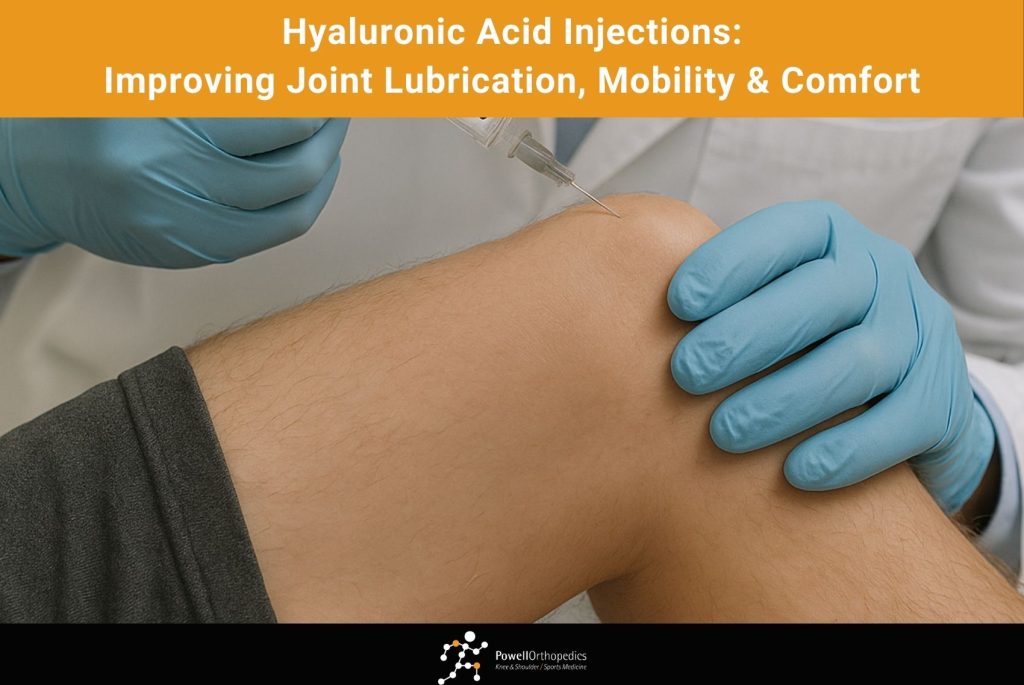
Hyaluronic acid injections — sometimes called viscosupplementation — involve injecting a purified, medical-grade gel directly into the affected joint.
This gel:
- Mimics the body’s natural joint fluid
- Helps reduce friction during movement
- Cushions and protects joint surfaces
- Supports smoother, more comfortable motion
Depending on the formulation, treatment may involve:
- A single injection
- A series of 3–5 weekly injections
- Extended-release formulations, depending on your joint needs
Your physician will determine which formulation is most appropriate.
Conditions Hyaluronic Acid Injections Can Help Treat
Hyaluronic acid injections are most commonly used for:
| Condition | Benefit |
| Osteoarthritis (mild to moderate) | Improves lubrication, reduces pain, slows wear progression |
| Cartilage thinning | Reduces friction over roughened surfaces |
| Chronic joint stiffness | Helps restore smoother mobility |
| Joint pain that persists despite physical therapy | Creates a more comfortable environment for movement |
These injections are especially useful for individuals who:
- Want to stay active
- Wish to avoid or delay future surgical interventions
- Have not found sufficient relief with oral medication alone
How the Injection is Performed
Step-by-Step Overview
- The joint area is cleaned using sterile technique.
- A local anesthetic may be used to reduce any temporary discomfort.
- If there is excess joint fluid causing swelling, it may be gently and safely aspirated (removed) before the injection.
- The hyaluronic acid gel is injected directly into the joint space.
- If needed, ultrasound guidance may be used to ensure precise placement.
The injection usually takes just a few minutes, and patients typically resume normal light activity the same day.
How Hyaluronic Acid Works in the Joint
Once inside the joint, hyaluronic acid:
- Improves lubrication, reducing stress on cartilage
- Absorbs shock, acting as a protective buffer
- Helps joint surfaces glide more smoothly
- Reduces friction, which often reduces inflammation
- May stimulate the body to produce more natural hyaluronic acid
Patients often describe the difference as the joint feeling “less stiff”, “smoother when bending”, or “not as heavy or achy.”
Expected Timeline of Relief
| Time After Injection | What to Expect |
| First 48–72 hours | Mild soreness may occur; avoid high-impact activity |
| Week 1–2 | Gradual reduction in stiffness and pain |
| Week 3–6 | Peak improvement typically occurs during this period |
| Months 2–6+ | Relief may last several months, depending on joint demands |
Some patients benefit from repeat injections every 6–12 months if symptoms return.
Benefits of Hyaluronic Acid Injections
- Improves joint lubrication for smoother movement
- Reduces pain during daily and recreational activities
- Supports joint protection and slower wear progression
- Allows more comfortable physical therapy participation
- No systemic side effects like oral medications may cause
This treatment is particularly helpful for individuals who are active and want to remain mobile without surgery.
How Hyaluronic Acid Differs from Cortisone Injections
| Cortisone | Hyaluronic Acid |
| Reduces inflammation | Improves lubrication and cushioning |
| Works quickly (fast relief) | Works gradually (more natural change) |
| Relief may be short-term | Relief may last several months |
| Not designed for long-term repeated use | Can be safely repeated at intervals |
| Does not improve joint fluid quality | May stimulate healthier joint fluid production |
Many patients benefit from combining both treatments at different phases of the recovery plan — cortisone when inflammation is high, hyaluronic acid when lubrication is needed.
Who is a Good Candidate?
You may benefit from hyaluronic acid injections if you:
- Have mild to moderate osteoarthritis
- Experience stiffness or grinding with joint movement
- Want to remain active and functional without surgery
- Have had limited relief from oral pain relievers or topical creams
- Respond well to physical therapy but continue to experience joint pain
- Prefer biologic or joint-preserving treatments over medication escalation
Patients with severe, advanced cartilage degeneration can still benefit, but relief may be less pronounced.
When to Seek Care Immediately
Although complications are rare, contact our office promptly if you experience:
- Increasing redness or warmth at the injection site
- Fever or chills
- Rapid swelling
- Severe pain that does not improve within 48–72 hours
- Numbness, tingling, or inability to move the joint
These may indicate an infection, allergic response, or other complication that requires timely evaluation.
Patient-Friendly Q&A
How long does the injection last?
Most patients experience relief lasting 3–6 months, sometimes longer depending on activity demands and arthritis severity.
Does the injection hurt?
Discomfort is generally mild and temporary. Many patients feel only pressure.
Can I walk or exercise afterward?
Yes — resume normal daily activity, but avoid strenuous impact exercise for 24–48 hours.
Can I repeat the injection in the future?
Yes. Many patients receive periodic injections as part of long-term joint management.
Will I still need physical therapy?
Yes — therapy improves muscle support, alignment, and movement mechanics, which enhance and prolong the benefits of injection therapy.
Protect Your Joint Function — Stay Active, Strong, and Supported
Hyaluronic acid injections are not a standalone cure — they are an important tool to make movement more comfortable, so you can stay active, strong, and independent.
The most effective treatment combines:
- Joint-friendly exercise
- Muscle strengthening
- Movement pattern correction
- Pain management
- Periodic injection support when appropriate
We guide every step of this process.
Schedule a Consultation
If joint stiffness, clicking, or daily pain is affecting your mobility, we are here to help restore comfort and confidence in your movement.
Powell Orthopedics
1450 East Zion Rd., Suites 6 & 10
Fayetteville, AR 72703
Phone: (479) 582-4647
Website: powellorthopedics.com
Request an Appointment: https://powellorthopedics.com/appointments/