
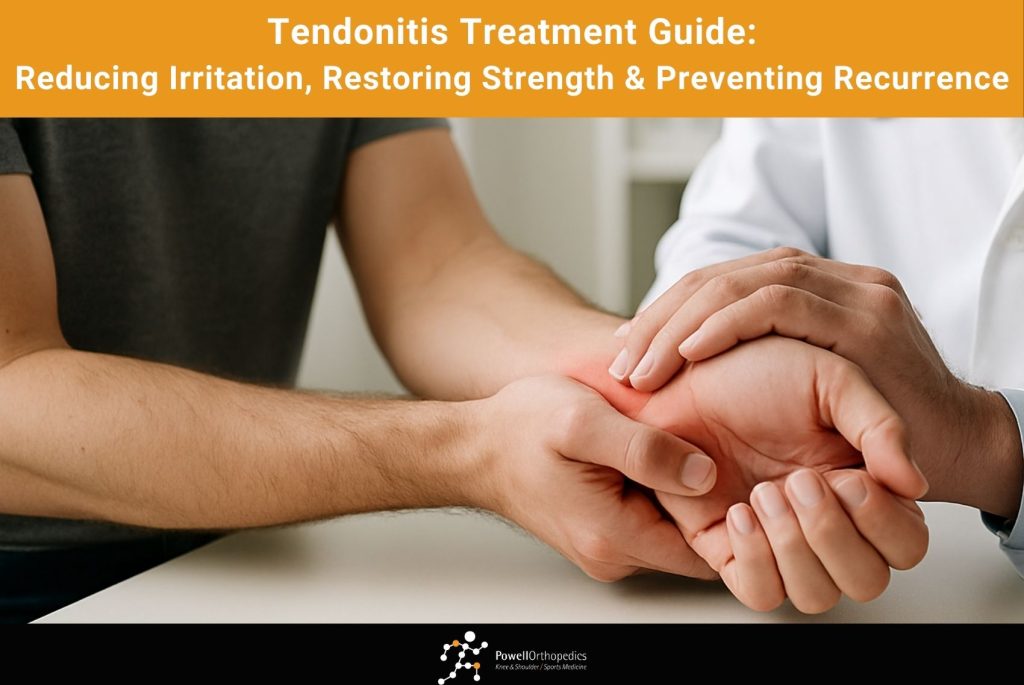
Understanding Tendonitis
A tendon is a strong, flexible band of connective tissue that attaches muscle to bone. Tendons allow muscles to move your joints — every time you lift, bend, reach, grip, walk, or rotate, your tendons are working.
Tendonitis occurs when a tendon becomes irritated, inflamed, or overloaded, often due to repetitive strain, sudden increase in activity, improper movement mechanics, or aging-related changes in tendon flexibility. This inflammation causes:
- Pain near a joint
- Swelling or thickening of the tendon
- Stiffness that worsens with motion
- Tenderness to touch
- Reduced strength or mobility
Tendonitis can occur anywhere in the body, but is especially common in:
- Shoulder (rotator cuff tendonitis)
- Elbow (tennis elbow or golfer’s elbow)
- Wrist (flexor and extensor tendon irritation)
- Knee (patellar tendonitis / “jumper’s knee”)
- Achilles tendon (Achilles tendonitis)
- Foot (plantar fascia involvement often overlaps with heel pain)
Tendonitis ranges from mild irritation to chronic tendon degeneration — but with the right treatment approach, pain and mobility can be significantly improved.
At Powell Orthopedics, we tailor tendonitis treatment to the individual, focusing on resolving irritation while addressing the root cause to prevent recurrence.
What Causes Tendonitis?
Tendonitis rarely comes from a single event. Instead, it results from repeated stress placed on a tendon faster than it can adapt.
Common Contributing Factors
| Factor | How It Causes Tendonitis |
| Repetitive motion | Repeated strain without rest leads to inflammation |
| Sudden increase in activity | Increasing exercise intensity too quickly |
| Weak or unbalanced muscles | Overloads specific tendons to compensate |
| Poor posture or movement mechanics | Increases tendon stress over time |
| Tight muscles | Pull excessively on tendons during motion |
| Overtraining or inadequate recovery | Not giving tissues time to heal |
| Age-related tendon changes | Tendons lose some elasticity, making them more prone to irritation |
In many cases, tendonitis indicates that movement patterns need to be retrained and supportive muscles strengthened.
Symptoms of Tendonitis
Tendonitis symptoms generally follow a recognizable pattern:
- Pain during movement of the affected joint
- Pain that worsens with repetitive use
- Morning stiffness or stiffness after inactivity
- Tenderness directly along the tendon
- Reduced strength or endurance of the muscle/tendon unit
- Swelling or thickening in chronic cases
Pain may start mild and become more persistent if the tendon continues to be strained.
Why Early Treatment Matters
If tendonitis is not addressed early, the tendon may begin to degenerate, a condition known as tendinosis. Over time, this can lead to:
- Chronic pain
- Loss of strength
- Reduced joint stability
- Increased risk of tendon tears
Early treatment helps restore tendon health and prevent long-term damage.
How Tendonitis Is Diagnosed
Diagnosis is based on:
1. History and Symptom Review
- When and where pain occurs
- What movements aggravate symptoms
- Recent changes in activity level or training
2. Physical Examination
Your provider will assess:
- Pain location and severity
- Movement patterns
- Joint alignment and flexibility
- Muscle strength and compensation patterns
3. Imaging (When Needed)
| Study | Purpose |
| Ultrasound | Shows tendon inflammation or thickening |
| MRI | Identifies tendon degeneration or partial tears |
| X-ray | Used to rule out bone involvement or arthritis contribution |
Most cases are diagnosed clinically and do not require imaging unless symptoms persist beyond early treatment.
Treatment Options at Powell Orthopedics
Tendonitis responds best to active rehabilitation — not just rest. Our treatment approach focuses on relieving inflammation while correcting movement factors that contributed to the irritation.
1. Activity Modification
Instead of stopping activity completely, we adjust:
- Exercise intensity
- Technique
- Training volume or rotation
- Ergonomics (workstation setup, repetitive strain patterns)
The goal is to reduce strain without losing strength or mobility.
2. Physical Therapy and Movement Retraining
This is the most important part of tendonitis recovery.
Therapy focuses on:
- Stretching tight muscle groups that overload the tendon
- Strengthening weak or underused muscles
- Correcting biomechanics and movement mechanics
- Gradual load progression to restore tendon strength
In many cases, tendonitis requires eccentric training, a specific strengthening method proven to promote tendon remodeling and recovery.
3. Anti-Inflammatory Medication (When Appropriate)
NSAIDs may provide short-term relief, especially early in the recovery process. They are used as part of a combined approach — not as a standalone treatment.
4. Bracing, Taping, or Supportive Devices
Bracing or taping decreases stress on the tendon while it heals, especially during work or athletic activity. These are used temporarily while strength improves.
5. Injection Therapy
Depending on severity and location:
| Injection Type | Benefit |
| Corticosteroid injection | Reduces inflammation, especially during flare-ups |
| Platelet-Rich Plasma (PRP) | Supports tendon healing in chronic cases; stimulates natural repair |
PRP is often recommended for tendonitis lasting longer than 3 months, especially when tendon degeneration is present.
6. Gradual Return to Activity
Returning to full activity too quickly can restart the irritation cycle.
We create stepwise progression plans to:
- Safely rebuild tendon endurance
- Prevent reinjury
- Support return to sport, fitness, or physical work
When to Seek Care Immediately
While most tendonitis is not urgent, seek same-day evaluation if you experience:
- Sudden sharp pain in a tendon during exercise or lifting
- Rapid swelling or bruising around a tendon
- A popping sensation followed by weakness or inability to move the joint
- Difficulty bearing weight or lifting the affected limb
These symptoms may indicate a partial or complete tendon tear rather than simple tendonitis.
Patient-Friendly Q&A
Will tendonitis go away on its own?
Not always. Rest alone often improves symptoms temporarily, but pain usually returns if the tendon is not strengthened and mechanics are not corrected.
Should I stop using the injured area?
No — complete rest weakens the tendon. The key is guided, progressive exercise, not immobilization (unless tear is suspected).
How long does tendonitis recovery take?
Most patients improve within 4–8 weeks, depending on severity and consistency with therapy.
Does tendonitis mean I have arthritis?
No. Tendonitis involves tendon irritation, while arthritis affects joint cartilage.
Can tendonitis return?
Yes — unless the underlying cause (movement pattern, muscle imbalance, or training volume) is addressed. That is why structured therapy is essential.
You Can Recover — With the Right Plan
Tendonitis can be frustrating, especially when it interferes with work, exercise, or daily tasks. But with the correct treatment approach — focusing on healing + movement retraining + strength rebuilding — most patients make a strong recovery and return to full activity.
We are here to guide you through every stage of healing.
Schedule Your Evaluation
Powell Orthopedics
1450 East Zion Rd., Suites 6 & 10
Fayetteville, AR 72703
Phone: (479) 582-4647
Website: powellorthopedics.com
Request Appointment: https://powellorthopedics.com/appointments/